

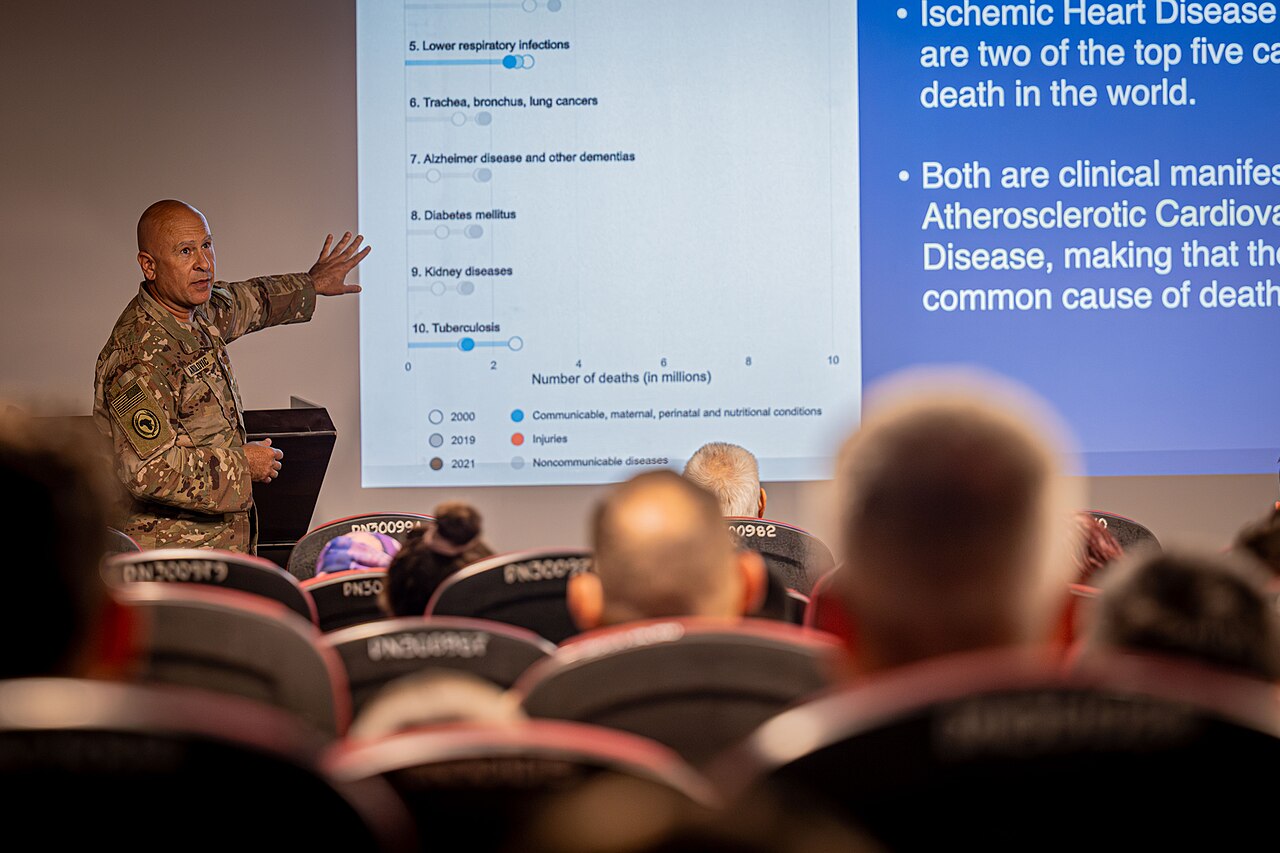
Every month, the Expeditionary Medical Facility on Camp Lemonnier hosts medical practitioners from the U.S., France, Japan, Italy and Spain to present and exchange information, aiming to increase interoperability for future operations and procedures. Taken on May 29, 2025. Public domain photo by U.S. Navy Petty Officer 2nd Class Jerome Fjeld
If you’ve never been to a medical conference before, making sense of the schedule ahead of time can be overwhelming at first. We covered in our last tip sheet what a medical conference is and how it fits into regular health reporting, but now we’ll dig deeper to help you understand what all the different types of events and sessions are that happen at one.
Some things on the schedule, such as plenaries and oral abstracts, are going to be top of your list for attending. Others, such as hands-on skills workshops or mentoring lunches may not even be open to you and wouldn’t offer much news value anyway. Here’s an overview of the many types of events and activities you can expect to see on the official schedule and in signage after you arrive.
- Opening and closing receptions — These social events are exactly what they sound like, and they can be one of the most fun events at conferences. They offer food, sometimes free drinks, and often music and dancing. They are also a good opportunity to begin meeting regular attendees at the conferences who may become helpful sources.
- Plenary sessions — These large, featured sessions are intended for high attendance, sometimes as much as everyone at the conference if there is a space to accommodate them all. There are rarely other sessions competing with plenaries — they are intended to be the main event — but often they cannot accommodate all attendees, so they may also be live-streamed or have overflow rooms if the main room gets full. Plenaries often have featured speakers for keynote addresses, but they may also feature particularly groundbreaking new research or a particular topic that is especially relevant right then.
- Continuing Medical Education (CME) sessions — These provide ongoing education in specific areas of medicine so attendees can keep their knowledge and certifications current.
- Debates and “controversy” sessions — These often provide an overview to a particularly timely or controversial issue in the field or even involve an actual debate with one or more presenters offering opposing viewpoints and then providing rebuttals to the other presenters’ view. These can be challenging to cover in an actual article, but they can be very useful for helping you understand the nuances of ongoing clinical conversations and controversies in the field, and they may provide story ideas for later features. For example, ACOG once presented a debate related to use of optional cesarean deliveries, and this year’s ObesityWeek features a session called “Metabolically Healthy Obesity — Scientific Paradigm Shift or Medical Myth?” with a debate-rebuttal format.
- Oral abstracts — These brief research presentations are what journalists cover most often, and they generate nearly all headlines from conferences. The research presented is usually not yet peer-reviewed and still in progress, but it will likely end up as a peer-reviewed paper eventually; sometimes the oral abstract is presented simultaneously with a just-published paper on the research. Presenters include medical students, postdoctoral researchers, physicians, company representatives, clinical trial investigators, and other types of researchers, all of whom give an overview of their research in 10-20 minutes each using slides. The presenter is most often the lead author, but it’s sometimes the senior author or a secondary author.
Sometimes the slides can be downloaded from the conference’s online platform, but most often journalists need to take photos of each slide. (A few conferences may require you to get permission to take photos, so read each conference’s media guidelines and ask the media/press room representatives if you’re unsure.) Oral abstracts are usually grouped into sessions ranging from one to two hours and include somewhere from four to 10 abstracts. Some conferences allow questions after each presentation while others require all questions to wait until after the last presentation. A few conferences, mostly oncology ones, will provide “discussants” who are not involved with any of the research and offer their expert commentary — an extremely useful feature for journalists!
- Research posters — These are similar to oral abstracts, but all the relevant information is presented on a single poster ranging in size from 2’x3’ to about 6’x8’. In addition to typical research studies, they can include clinical innovations, surveys, state-of-the-industry or med school topics, or quality improvement initiatives. Though not usually presented orally, some conferences may schedule brief oral presentations of two to three minutes per poster in a speedy round-robin style.
Most often, there is an established time frame of two to three hours on the schedule when a study author (usually the lead author) is expected to be at the poster to answer questions. This is also the best time to get outside comments from other attendees about posters. At some conferences, it’s essential to visit during these scheduled times because it may be the only time the poster is on display, particularly for the larger conferences where there are too many posters to display all of them during the entire conference. At other conferences, all the posters might be on display for the full duration of the conference. The posters are most often in the exhibition hall (which means they can only be accessed during exhibit hall hours, though sometimes the poster area is open when the exhibit area is closed).
- Exhibition hall — These are usually the largest part of a meeting in terms of square footage. These are the expo-like areas where companies, medical schools, nonprofit groups and other organizations have booths for attendees to learn about their products, services or opportunities. This is where you find large pharmaceutical company displays — often with free coffee or snacks — as well as all the swag you can dream of. If you collect swag, expect to go home with loads of pens, cheap cell phone accessories, candies, magnets, pins, stickers, branded bags, socks, stress balls (often in the shape of something medical), and other novelty items. Aside from free coffee and a super cheap “lunch” in servings the size of grocery store samples, the exhibition hall can be a great place for networking, getting story ideas, and collecting brochures about medications, new technologies, research, or patient organizations. Most conferences have at least one networking or social function in the exhibit hall, often with free food and drinks.
- Scheduled exhibit hall talks or demonstrations — These are always in the exhibit hall and are nearly always sponsored by a company or other organization. They sometimes use these times to present original research, depending on the conference, and other times simply demonstrate a product or procedure or discuss that company’s pipeline of products.
- Industry-sponsored CME sessions — These may be in the exhibit hall or in a meeting room after hours (when the regularly scheduled conference sessions are done for the day). They can be similar to the conference’s regular CME sessions, but they are explicitly sponsored by a pharmaceutical or medical device company, such as a vaccine manufacturer providing an educational session on one of their vaccines.
- Award ceremonies and/or lectures — Award ceremonies are exactly what they sound like and rarely have news value for journalists, but award lectures can be great for getting an overview of a specific topic or generating feature ideas.
- Committee or section meetings — These can vary greatly by conference and organization. They may be open only to committee members, only to organization members, or to any attendees, including journalists. They may be informal stakeholder discussions, more formal organizational updates, presentations of oral abstracts specific to that specialty, or a hybrid of any or all of these. For example, at AAP meetings, section meetings will include oral abstract presentations that journalists can attend and report on, but other committee meetings are closed to journalists and deal with more internal minutiae that lacks news value. At a meeting of the Childhood Arthritis and Rheumatology Research Alliance, these committee meetings have included research presentations — both ones journalists can report on and ones not yet able to be made public — and more informal discussions with patient advocates. The latter can be helpful to journalists to understand the topic better or meet potential sources, even if they cannot report on the actual content of the meeting.
- Alumni mixers — These are typically private events for a medical school’s alumni to network at, but sometimes journalists are welcome at these events too. It doesn’t hurt to ask or just show up because they can be useful in meeting institutional PIOs, physicians and researchers — and again often have free food and drinks.
- Clinical workshops or skill development sessions — These often hands-on sessions usually cost extra money and are rarely open to journalists.
- Pre-meeting courses — These are held before the official conference begins, either as a workshop lasting a couple hours or as a full one-day session. They’re usually aimed at young or new doctors or those wanting to learn about a subspecialty. Sometimes they require an extra fee and sometimes not; sometimes they are open to the media, other times not.
- Mentoring sessions, luncheons or receptions — These are often closed to journalists and are unlikely to offer much news value.
- Tours and field trips — These can be fun outings only for social reasons or educational visits to nearby hospitals or research facilities. There is usually an additional fee, even for journalists, and journalists may not be allowed to attend some of these.
- Charity and advocacy events — These can include 5K fun runs, political rallies specific to that specialty, and other events with a specific philanthropic or political aim. They might also include training for policy advocacy or activities intended to recruit advocates. These are nearly always public events, though actually participating (such as running in a 5K) may require a fee and advance registration.
See the next tip sheet on how to prepare for conference coverage BEFORE you arrive.
Source link
